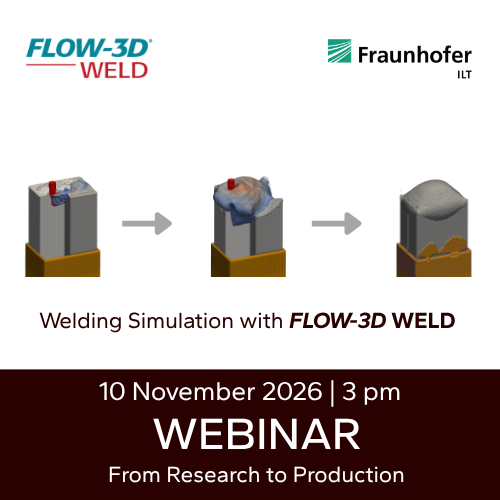
Webinar Welding Simulation
Hosted by our FLOW-3D WELD application engineers and an expert from the Fraunhofer Institute for Laser Technology ILT.
Join the Webinar
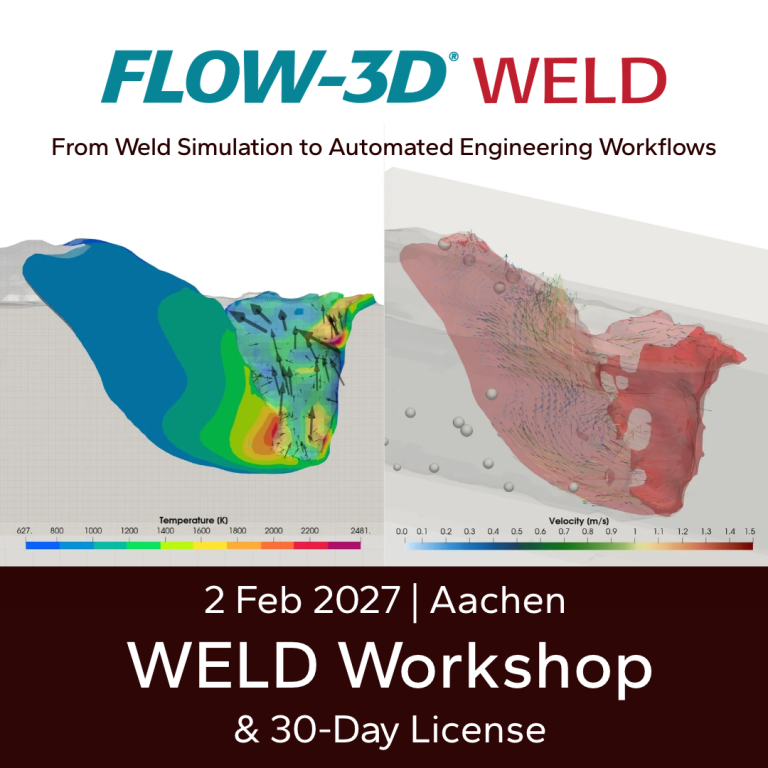
In this webinar, we will introduce FLOW-3D WELD and show how simulation can help us better understand what happens during welding, from heat transfer and melt pool flow to keyhole behavior, solidification, and defect formation.
From Research to Production: Welding Simulation with FLOW-3D WELD
Welding processes are complex, and many of the most important phenomena happen inside the melt pool, where they are difficult to observe directly.
We will start with the basic idea behind FLOW-3D welding simulations and then look at examples from both academia and industry. For researchers, simulation can provide deeper insight into the physics of the process and complement experimental work. For industry, it can help investigate defects, compare process parameters, reduce trial-and-error testing, and support process development and optimization.
What you will see
- The basic principles behind welding simulation with FLOW-3D WELD
- How simulation can help understand melt pool and keyhole dynamics
- Examples from academic research and industrial applications
- How simulation can support experiments and process optimization
Who should attend this webinar?
This webinar is suitable for researchers, students, welding and process engineers, R&D teams, and manufacturing engineers working with welding, materials, laser processing, or simulation.
Presenters
Tin Brdnik, Application Engineer, Flow Science
Mo Sattari, Application Engineer, Flow Science
with a special guest expert from Fraunhofer Institute for Laser Technology ILT.
Registration
Participation is free of charge and non-binding. Simply register via our online form to secure your place. We look forward to welcoming you!
For any inquiries, please contact Tin Brdnik and Mo Sattari at sales(at)flow3d.de.